
Premium Phosphosite-Specific 7TM Antibodies
Your Resource for GPCR Research
Select Your Country of Delivery below

Premium Phosphosite-Specific 7TM Antibodies

Phosphorylation of intracellular serine and threonine residues is the most important post translational modification of G protein-coupled receptors (GPCRs) also called heptahelical or seven transmembrane receptors (7TMR). After agonist exposure, these receptors acquire an active conformation, which is recognized by a family of highly specialized GPCR kinases (GRKs). Agonist-driven phosphorylation by GRKs regulates acute receptor desensitization, arrestin recruitment, internalization, post-activation signaling, long-term tolerance and drug addiction. Phosphosite-specific 7TM antibodies are designed to specifically detect agonist-activated GPCRs. In fact, recent work shows that ligand profiling using phosphosite-specific 7TM antibodies provides valuble information on ligand bias beyond that obtained with conventional ß-arrestin recruitment assays. Phosphosite-specific 7TM antibodies are novel tools for GPCR research that can be used to:

  • profile agonist properties of novel GPCR ligands
  • decipher the phosphorylation barcode of GPCRs
  • determine the spatial and temporal dynamics of receptor phosphorylation
  • identify relevant kinases and phosphatases for GPCR phosphorylation and dephosphoryation

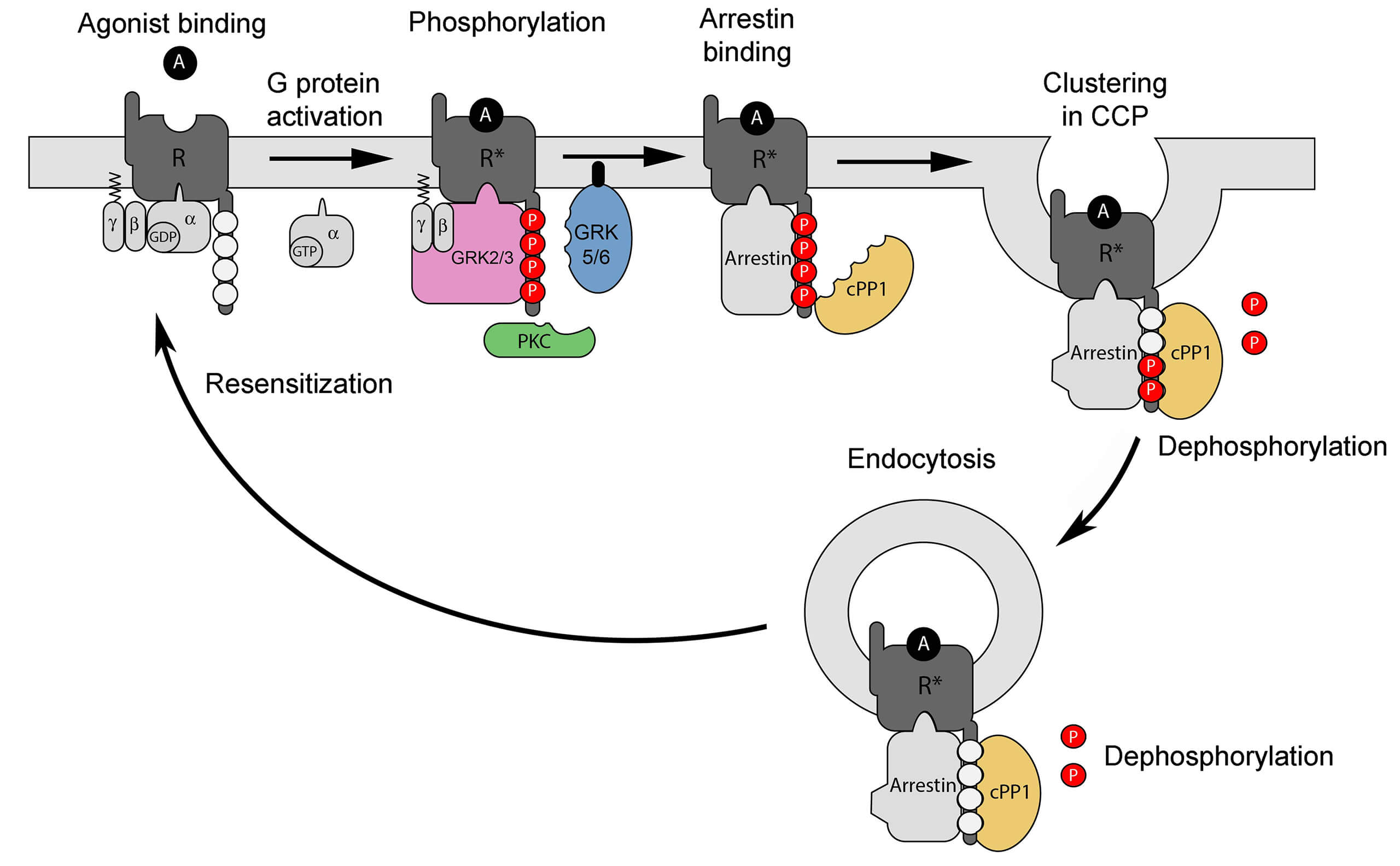
Lifecycle3


Schematic representation of the G protein-coupled receptor phosphorylation / dephosphorylation cycle. GRK, G protein-coupled receptor kinase; PKC, protein kinase C; cPP1, catalytic subunit of protein phosphatase 1; R*, activated GPCR; CCP, clathrin-coated pit. 

Close filters
13 From 37
No results were found for the filter!
NEW
 Immunohistochemical identification of Atypical Chemokine Receptor 3 in Heart
ACKR3 (GP-IHC-grade), Atypical Chemokine...
The ACKR3 receptor antibody is directed against the distal end of the carboxyl-terminal tail of human Atypical Chemokine Receptor 3. It can be used to detect total ACKR3 receptors in Western blots independent of phosphorylation. The...
CHF400.00 *
NEW
Agonist-induced Serine412 phosphorylation of the β1-Adrenoceptor
pS412-β1 (phospho-β1-Adrenoceptor Antibody)
Serine412 (S412) is a major phosphorylation site of the β1 adrenoceptor. The pS412-β1 antibody detects phosphorylation in response to high- and low-efficacy agonists but not after PKC activation. S412 phosphorylation is primarily...
CHF400.00 *
NEW
Agonist-induced Threoine347/Serine349 phosphorylation of GPR183
pT347/pT349-GPR183 (phospho-GPR183 Antibody)
Threonine347/Threonine349 (T347/T349) is major phosphorylation site of human GPR183 receptor. The pT347/pT349-GPR183 antibody detects phosphorylation in response to agonists. T347/T349 phosphorylation is likely to be involved in...
CHF400.00 *
NEW
Agonist-induced Serine346/Serine347 phosphorylation of the Angiotensin Receptor 1
pS346/pS347-AT1 (phospho-Angiotensin Receptor 1...
Serine346/Serine347 (S346/S347) is major phosphorylation site of the Angiotensin Receptor 1 (AT1). The pS346/pS347-AT1 antibody detects phosphorylation in response to agonists. S346/S347 phosphorylation is likely to be involved in...
CHF400.00 *
NEW
Agonist-induced Serine335/Threonine336 phosphorylation of the Angiotensin Receptor 1
pS335/pT336-AT1 (phospho-Angiotensin Receptor 1...
Serine335/Threonine336 (S335/T336) is major phosphorylation site of the Angiotensin Receptor 1 (AT1). The pS335/pT336-AT1 antibody detects phosphorylation in response to agonists. S335/T336 phosphorylation is likely to be involved in...
CHF400.00 *
NEW
Validation of the β2-Adrenoceptor in transfected HEK293 cells
β2 (GP-non-phospho), β2-Adrenoceptor Antibody,...
The non-phospho- β2 antibody is directed against the third intracellular loop of human β2 . It can be used to detect total β2 receptors in Western blots independent of phosphorylation. The non-phospho- β2 antibody can also be used to...
CHF400.00 *
NEW
Validation of the Complement C5a Receptor 1 in transfected HEK293 cells
C5a1 (GP-non-phospho), Complement C5a Receptor...
The non-phospho-C5a1 receptor antibody is directed against the distal end of the carboxyl-terminal tail of human C5a1. It can be used to detect total C5a1 receptors in Western blots independent of phosphorylation. The non-phospho-C5a1...
CHF400.00 *
NEW
KO-Validated
 Western blot analysis of G Protein-coupled Receptor 20 in mouse tissues in vivo.
mGPR20 (non-phospho-G Protein-Coupled Receptor...
The GPR20 receptor antibody is directed against the distal end of the carboxyl-terminal tail of mouse GPR20. It can be used to detect total GPR20 receptors in Western blots independent of phosphorylation. The GPR20 antibody can also be...
CHF400.00 *
NEW
KO-Validated
Immunohistochemical identification of G Protein-coupled Receptor 20 in mouse spleen.
mGPR20 (IHC-grade), G Protein-Coupled Receptor...
The GPR20 receptor antibody is directed against the distal end of the carboxyl-terminal tail of mouse GPR20. It can be used to detect total GPR20 receptors in Western blots independent of phosphorylation. The GPR20 antibody can also be...
CHF400.00 *
NEW
Agonist-induced Serine401 phosphorylation of the Neurotensin Receptor
pS401-NTS1 (phospho-Neurotensin Receptor 1...
Serine401 (S401) is major phosphorylation site of the Neurotensin Receptor 1 (NTS1). The pS401-NTS1 antibody detects phosphorylation in response to agonists. S401 phosphorylation is likely to be involved in efficient ligand sequestration...
CHF400.00 *
NEW
 Agonist-induced Serine403/Serine404 phosphorylation of the Neurotensin Receptor 1
pS403/pS404-NTS1 (phospho-Neurotensin Receptor...
Serine403/Serine404 (S403/S404) is major phosphorylation site of the Neurotensin Receptor 1 (NTS1). The pS403/pS404-NTS1 antibody detects phosphorylation in response to agonists. S403/S404 phosphorylation is likely to be involved in...
CHF400.00 *
NEW
Agonist-induced Serine409/Serine410 phosphorylation of the Neurotensin Receptor 1
pS409/pS410-NTS1 (phospho-Neurotensin Receptor...
Serine409/Serine410 (S409/S410) is major phosphorylation site of the Neurotensin Receptor 1 (NTS1). The pS409/pS410-NTS1 antibody detects phosphorylation in response to agonists. S409/S410 phosphorylation is likely to be involved in...
CHF400.00 *
NEW
Immunohistochemical identification of Serine409/Serine410 phosphorylation of Neurotensin Receptor 1 in mouse brain.
pS409/pS410-NTS1 (IHC-grade phospho-Neurotensin...
Serine409/Serine410 (S409/S410) is major phosphorylation site of the Neurotensin Receptor 1 (NTS1). The pS409/pS410-NTS1 antibody detects phosphorylation in response to agonists. S409/S410 phosphorylation is likely to be involved in...
CHF600.00 *
NEW
Immunohistochemical identification of G Protein-coupled Receptor 87 in kidney.
GPR87 (IHC-grade), G Protein-Coupled Receptor...
The GPR87 antibody is directed against the distal end of the carboxyl-terminal tail of mouse, rat and human GRP87. It can be used to detect total GPR87 receptors in Western blots independent of phosphorylation. The GPR87 antibody can...
CHF400.00 *
NEW
Constitutive Serine296/Serine297 phosphorylation of the FFA Receptor 2
pS296/pS297-FFA2 (phospho-FFA2 Antibody)
Serine296/Serine297 (S296/S297) is major phosphorylation site of the FFA Receptor 2 (FFA2). The pS296/pS297-FFA2 antibody detects constitutive phosphorylation of FFA2.
CHF400.00 *
NEW
Agonist-induced Threonine306/Threonine310 phosphorylation of the FFA2 Receptor
pT306/pT310-FFA2 (phospho-FFA2 Antibody)
Threonine306/Threonine310 (T306/T310) is major phosphorylation site of the FFA 2 Receptor (FFA2). The pT306/pT310-FFA2 antibody detects phosphorylation in response to agonists. T306/T310 phosphorylation is likely to be involved in...
CHF400.00 *
13 From 37

For further reading refer to:

Kliewer A, Reinscheid RK, Schulz S. Emerging Paradigms of G Protein-Coupled Receptor Dephosphorylation. Trends Pharmacol Sci. 2017 Jul;38(7):621-636. doi:10.1016/j.tips.2017.04.002. Epub 2017 May 4. Review. PubMed PMID: 28478994.

Miess E, Gondin AB, Yousuf A, Steinborn R, Mösslein N, Yang Y, Göldner M, Ruland JG, Bünemann M, Krasel C, Christie MJ, Halls ML, Schulz S, Canals M. Multisite phosphorylation is required for sustained interaction with GRKs and arrestins during rapid μ-opioid receptor desensitization. Sci Signal. 2018 Jul 17;11(539). pii: eaas9609. doi: 10.1126/scisignal.aas9609. PubMed PMID: 30018083.

Kliewer A, Schmiedel F, Sianati S, Bailey A, Bateman JT, Levitt ES, Williams JT, Christie MJ, Schulz S. Phosphorylation-deficient G-protein-biased μ-opioid receptors improve analgesia and diminish tolerance but worsen opioid side effects. Nat Commun. 2019 Jan 21;10(1):367. doi: 10.1038/s41467-018-08162-1. PubMed PMID: 30664663; PubMed Central PMCID: PMC6341117.

Mann A, Moulédous L, Froment C, O'Neill PR, Dasgupta P, Günther T, Brunori G, Kieffer BL, Toll L, Bruchas MR, Zaveri NT, Schulz S. Agonist-selective NOP receptor phosphorylation correlates in vitro and in vivo and reveals differential post-activation signaling by chemically diverse agonists. Sci Signal. 2019 Mar 26;12(574). pii: eaau8072. doi: 10.1126/scisignal.aau8072. PubMed PMID: 30914485; PubMed Central PMCID: PMC6934085.

Saaber F, Schütz D, Miess E, Abe P, Desikan S, Ashok Kumar P, Balk S, Huang K, Beaulieu JM, Schulz S, Stumm R. ACKR3 Regulation of Neuronal Migration Requires ACKR3 Phosphorylation, but Not β-Arrestin. Cell Rep. 2019 Feb 5;26(6):1473-1488.e9. doi: 10.1016/j.celrep.2019.01.049. PubMed PMID: 30726732.

Glück L, Loktev A, Moulédous L, Mollereau C, Law PY, Schulz S. Loss of morphine reward and dependence in mice lacking G protein-coupled receptor kinase 5. Biol Psychiatry. 2014 Nov 15;76(10):767-74. doi: 10.1016/j.biopsych.2014.01.021. Epub 2014 Feb 3. PubMed PMID: 24629717; PubMed Central PMCID: PMC4119866.

For further reading refer to: Kliewer A, Reinscheid RK, Schulz S. Emerging Paradigms of G Protein-Coupled Receptor Dephosphorylation. Trends Pharmacol Sci. 2017 Jul;38(7):621-636.... read more »
Close window
Premium Phosphosite-Specific 7TM Antibodies

For further reading refer to:

Kliewer A, Reinscheid RK, Schulz S. Emerging Paradigms of G Protein-Coupled Receptor Dephosphorylation. Trends Pharmacol Sci. 2017 Jul;38(7):621-636. doi:10.1016/j.tips.2017.04.002. Epub 2017 May 4. Review. PubMed PMID: 28478994.

Miess E, Gondin AB, Yousuf A, Steinborn R, Mösslein N, Yang Y, Göldner M, Ruland JG, Bünemann M, Krasel C, Christie MJ, Halls ML, Schulz S, Canals M. Multisite phosphorylation is required for sustained interaction with GRKs and arrestins during rapid μ-opioid receptor desensitization. Sci Signal. 2018 Jul 17;11(539). pii: eaas9609. doi: 10.1126/scisignal.aas9609. PubMed PMID: 30018083.

Kliewer A, Schmiedel F, Sianati S, Bailey A, Bateman JT, Levitt ES, Williams JT, Christie MJ, Schulz S. Phosphorylation-deficient G-protein-biased μ-opioid receptors improve analgesia and diminish tolerance but worsen opioid side effects. Nat Commun. 2019 Jan 21;10(1):367. doi: 10.1038/s41467-018-08162-1. PubMed PMID: 30664663; PubMed Central PMCID: PMC6341117.

Mann A, Moulédous L, Froment C, O'Neill PR, Dasgupta P, Günther T, Brunori G, Kieffer BL, Toll L, Bruchas MR, Zaveri NT, Schulz S. Agonist-selective NOP receptor phosphorylation correlates in vitro and in vivo and reveals differential post-activation signaling by chemically diverse agonists. Sci Signal. 2019 Mar 26;12(574). pii: eaau8072. doi: 10.1126/scisignal.aau8072. PubMed PMID: 30914485; PubMed Central PMCID: PMC6934085.

Saaber F, Schütz D, Miess E, Abe P, Desikan S, Ashok Kumar P, Balk S, Huang K, Beaulieu JM, Schulz S, Stumm R. ACKR3 Regulation of Neuronal Migration Requires ACKR3 Phosphorylation, but Not β-Arrestin. Cell Rep. 2019 Feb 5;26(6):1473-1488.e9. doi: 10.1016/j.celrep.2019.01.049. PubMed PMID: 30726732.

Glück L, Loktev A, Moulédous L, Mollereau C, Law PY, Schulz S. Loss of morphine reward and dependence in mice lacking G protein-coupled receptor kinase 5. Biol Psychiatry. 2014 Nov 15;76(10):767-74. doi: 10.1016/j.biopsych.2014.01.021. Epub 2014 Feb 3. PubMed PMID: 24629717; PubMed Central PMCID: PMC4119866.

Recently viewed